
Equipment Financing vs. Leasing: Which Is Right for Your Business?
Equipment financing vs. leasing explained: loans, $1-buyout and FMV leases, EFAs, tax and ownership trade-offs, plus a total-cost comparison and checklist.
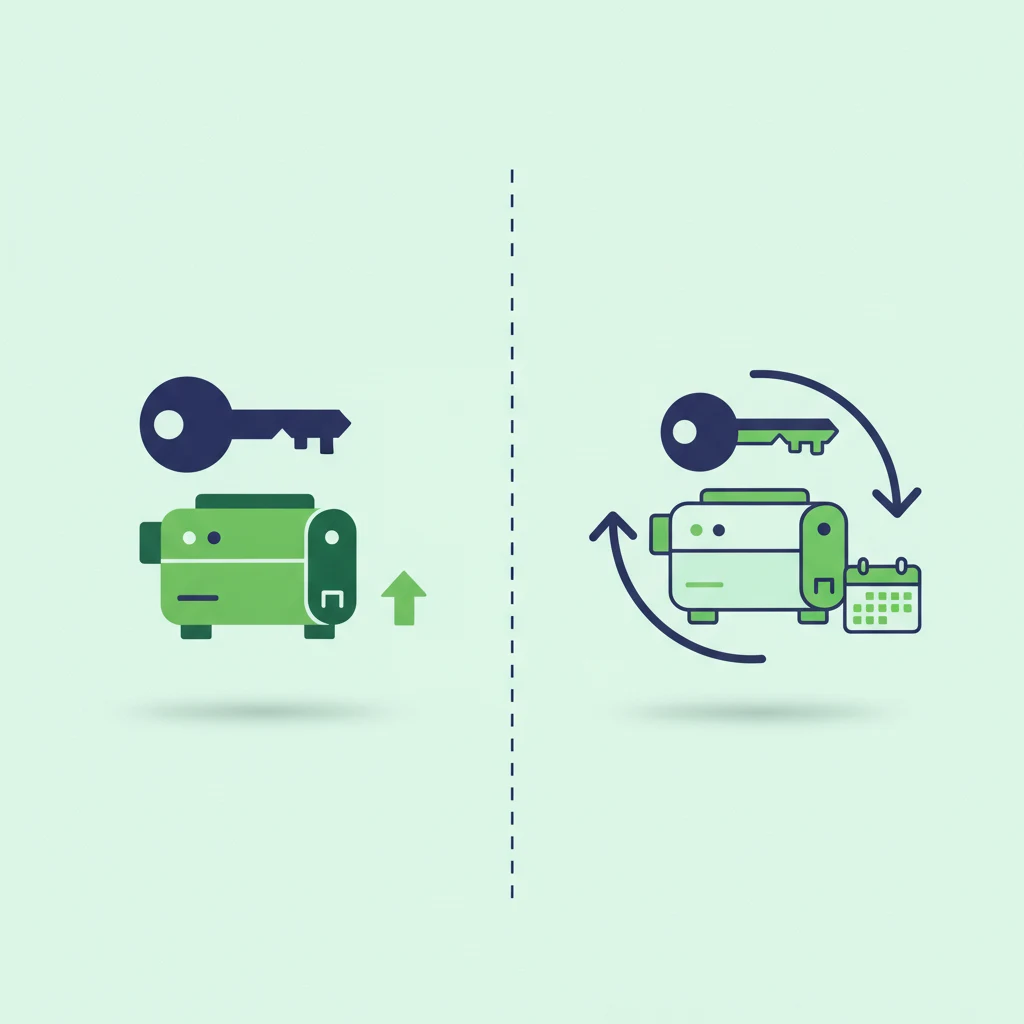
"Should I finance it or lease it?" is one of the most common — and most misunderstood — questions in business equipment decisions. The right answer depends on how long you'll use the gear, how fast it goes obsolete, your tax situation, and whether you want to own it at the end. This guide breaks down the real differences in plain English so you can match the structure to your business.
A quick note: FinanceToad is an independent comparison platform, not a lender, and we never guarantee approval. Every rate and dollar figure below is an illustrative example to show how the math works — not a quote.
The real difference: a loan vs. a lease
At its core, the choice comes down to ownership.
- With an equipment loan, you're buying the asset. You hold the title, the lender places a lien on it, and once you finish paying, you own it outright. You also absorb its resale value — or its obsolescence.
- With an equipment lease, a leasing company owns the asset and you pay to use it for a term. What happens at the end depends on the type of lease.
That single distinction — who owns it — ripples through your taxes, your flexibility, and your exposure to equipment going out of date. (For a broader walkthrough of how deals are structured, see how equipment financing works.)
The three structures you'll actually see
Most quotes fall into one of three buckets.
$1-buyout lease (a.k.a. capital lease)
You make lease payments, then buy the equipment for $1 at the end. Economically, this is almost identical to a loan — you're financing a purchase and will own the asset. Payments tend to be higher than an FMV lease because you're paying down the full value. It's a fit when you know you want to keep the equipment.
Fair-market-value (FMV) lease
At the end of the term, you can return the equipment, renew, or buy it for its fair market value. Monthly payments are usually lower because you're only paying for the use, not the full asset. FMV leases shine when you want flexibility or expect to upgrade — but if you buy at the end, your total cost can exceed a loan.
EFA (Equipment Finance Agreement)
An EFA looks like a lease on paper but functions like a loan: you're treated as the owner for tax purposes from the start, with a lien rather than a true lease. Many businesses use EFAs to get loan-style ownership with finance-company convenience.
Ownership, tax, flexibility, and obsolescence
Four trade-offs drive most decisions:
- Ownership. Loans, $1-buyout leases, and EFAs lead to ownership. A true FMV lease does not, unless you buy out at the end.
- Tax treatment. When you own (loan, $1-buyout, EFA), you may be able to depreciate the asset and potentially use the Section 179 deduction — see our Section 179 equipment tax deduction guide for 2026. With a true FMV lease, payments are often treated as a deductible operating expense instead. The best choice depends on your tax picture, so confirm with your accountant.
- Flexibility. FMV leases make it easy to return or upgrade. Loans lock you into the asset until it's paid off (though you can usually sell it).
- Obsolescence. If the equipment will be outdated in a few years, leasing shifts that risk to the leasing company. If it has a long, stable useful life, owning lets you keep using a paid-off asset for years.
When leasing wins
Leasing — especially an FMV lease — tends to be the stronger move when:
- The equipment involves fast-changing technology (computers, diagnostic gear, some software-bundled hardware) and you'll want to upgrade.
- You only need the equipment for a short or uncertain period.
- You want to preserve cash with lower monthly payments and minimal upfront cost.
- You value the option to walk away at the end without owning a depreciating asset.
When buying or financing wins
A loan, $1-buyout lease, or EFA tends to win when:
- The equipment has a long, stable useful life (many vehicles, construction and manufacturing gear, commercial kitchen equipment).
- You clearly want to own it and use it for years after it's paid off.
- You may benefit from depreciation or Section 179 in the purchase year.
- The asset holds resale value, so ownership has a tangible payoff.
A total-cost comparison (illustrative)
Numbers make the trade-offs concrete. Below is a simplified, illustrative comparison for a $50,000 machine over a 5-year (60-month) term. Real pricing depends on your credit, the equipment, and current market conditions — treat this as a teaching example, not a quote.
| Equipment loan | $1-buyout lease | FMV lease | |
|---|---|---|---|
| Approx. monthly payment | ~$980 | ~$1,000 | ~$820 |
| Down payment | ~$5,000 (10%) | $0 | $0 |
| End-of-term cost to own | $0 (already owned) | $1 | ~$10,000 (fair market value) |
| Total paid to own | ~$63,800 | ~$60,000 | ~$59,200 |
| Total paid if you return (FMV) | n/a | n/a | ~$49,200 |
| You own it at the end? | Yes | Yes | Only if you buy out |
| Best when… | Long-life gear, want to own | Want to own, prefer $0 down | Flexibility, may upgrade |
Read it this way: if you're certain you'll keep the machine, the $1-buyout lease and loan land close, and the FMV buyout often costs more once you add the end-of-term payment. But if there's a real chance you'll return or upgrade, the FMV lease's lower payments and walk-away option can make it the cheaper, lower-risk path.
A quick decision checklist
Run through these before you commit:
- Will I still want this exact equipment in 3–5 years? Yes leans toward owning; unsure leans toward an FMV lease.
- How fast does this category go obsolete? Fast → lease; slow → own.
- Do I want the lowest monthly payment or the lowest total cost? Lowest monthly often favors an FMV lease; lowest total-to-own often favors a loan or $1-buyout.
- What's my tax goal this year? Depreciation/Section 179 points to ownership; expensing lease payments points to a true lease. Confirm with your tax pro.
- How much cash do I want to keep on hand? Lower upfront and monthly cost favors leasing.
- Does the equipment hold resale value? High resale value strengthens the case for owning.
For a structured way to line up the actual quotes once you've picked a direction, our guide to how to compare equipment finance offers shows how to normalize APR, term, and total cost.
The bottom line
Equipment financing and leasing aren't rivals — they're tools for different jobs. Loans, $1-buyout leases, and EFAs are about owning long-life gear and potentially claiming depreciation or Section 179. FMV leases are about flexibility, lower payments, and offloading obsolescence risk on fast-changing equipment. Start with the ownership question, weigh tax and total cost, and let the math — not the monthly payment alone — guide you.
When you're ready to see real structures side by side for your specific purchase, you can compare equipment financing and leasing offers on FinanceToad at your own pace.
Keep reading
How Equipment Financing Works: A Plain-English Guide for Business Owners
Learn how equipment financing works in plain English: loans vs. leases, deal structure, typical terms, the step-by-step process, and mistakes to avoid.
Jun 22, 2026
Section 179 & Bonus Depreciation: Equipment Tax Write-Offs for 2026
A plain-English guide to Section 179 and bonus depreciation in 2026 — including how financed equipment still qualifies and a worked tax-savings example.
Jun 14, 2026
How to Compare Equipment Finance Offers: APR, Factor Rates & Hidden Fees
Two equipment finance offers with the 'same rate' can cost thousands apart. Learn APR vs factor rates, hidden fees, and how to compare total cost the right way.
Jun 10, 2026